Showing posts with label history. Show all posts

Sunday, March 22, 2020

The Inventor of Handwashing Died of a Flesh Wound

The Google Doodle of the Day on Saturday was a fascinating rabbit hole.  It features Ignaz Semmelweis, who was one of the first proponents of handwashing.

As an Austrian doctor and obstetrician during the mid 1800s, he noted that one clinic in the Vienna general hospital had a much lower rate of childbirth than the other.  He noted that in one maternity clinic the practitioners also dealt with the morgue, and the other one they didn't.  He did a series of experiments, trying to discover what the difference was to make the mortality rate so high in one clinic and not the other.  Through a process of elimination, he imagined that there were minuscule cadaverous materials that the doctors were bringing with them from the morgue, and was convinced that was the problem.  As an experiment, he asked them to clean their hands using a solution of chlorinated lime (because this was good at erasing the smell of corpses.)  The mortality rate went from 10-15% in that ward month to month down to 1-2%, and even a couple of months there were no mortalities.


Despite this evidence and more, the medical community scorned his ideas.  He had 20 years of rejection and people laughing at him.  He lost his post in Vienna, moved to Budapest and took to writing incendiary letters to his detractors and to obstetricians, calling them murderers.  In the end, his wife and his friends committed him to an asylum, where he died two weeks later of-- oh the irony- gangrene from an infected wound.

This chart courtesy of the Wikipedia article on Semmelweis.
The esteemed scientists who laughed at him believed in the idea of four humours-- that diseases were individual, and that the best way to right a person was by bloodletting.  20 years after his death, Louis Pasteur's theory of germs became widely accepted and would have been supported by the work of Semmelweis.

Semmelweis's struggle has been captured in plays, films, and operas. In fact, a 1938 film about him won the Best Short Film Oscar (One Reel) of 1939.  That Mothers Might Live. (video below)

Also, Semmelweis's plight has been immortalized in a psychological term known as the Semmelweis Reflex, which is the often reflexive tendency to reject new ideas or evidence because it contradicts established norms or beliefs.

And this could still happen today.  That's why it's so important to have an open mind and be willing to be persuaded by new evidence or knowledge.   (I'm looking at you #trumpsupporters)


Enjoy this movie-- I found it on Youtube, and its' pretty powerful.


Thumbnail biography of Ignaz Semmelweis (courtesy of Wikipedia)

Buy Genius Belabored On Amazon

Ignaz Philipp Semmelweis (1 July 1818 – 13 August 1865) was an Austrian-Hungarian physician and scientist, now known as an early pioneer of antiseptic procedures. Described as the "saviour of mothers", Semmelweis discovered that the incidence of puerperal fever (also known as "childbed fever") could be drastically cut by the use of hand disinfection in obstetrical clinics. Puerperal fever was common in mid-19th-century hospitals and often fatal. Semmelweis proposed the practice of washing hands with chlorinated lime solutions in 1847 while working in Vienna General Hospital's First Obstetrical Clinic, where doctors' wards had three times the mortality of midwives' wards. He published a book of his findings in Etiology, Concept and Prophylaxis of Childbed Fever. 
Buy The Doctor's Plague on Amazon

Despite various publications of results where hand washing reduced mortality to below 1%, Semmelweis's observations conflicted with the established scientific and medical opinions of the time and his ideas were rejected by the medical community. Semmelweis could offer no acceptable scientific explanation for his findings, and some doctors were offended at the suggestion that they should wash their hands and mocked him for it. In 1865, the increasingly outspoken Semmelweis supposedly suffered a nervous breakdown and was committed to an asylum by his colleagues. He died 14 days later, at the age of 47, from a gangrenous wound on his right hand which might have been caused by a beating from the guards. Semmelweis's practice earned widespread acceptance only years after his death, when Louis Pasteur confirmed the germ theory, and Joseph Lister, acting on the French microbiologist's research, practised and operated using hygienic methods, with great success.

Monday, April 29, 2019

Hamilton The Exhibition

Hamilton the Exhibition is now open at Northerly Island
on a peninsula near the Adler Planetarium.  It's not Weehawken
NJ, but it will have to do!\.
I had a great time attending the opening day of Hamilton the Exhibition, even though by the time I left the exhibit it was snowing in April.  Welcome to Chicago, Hamilton the Exhibition!

As you all know, I have been a big supporter of Hamilton since I first heard the soundtrack three years ago, and have chronicled on this page and on Facebook my obsession with Hamilton (I've seen it three times, and was so thrilled to meet the director Tommy Kail (and later Lin-Manuel Miranda) the creator at various events.  So I was excited to attend a press conference with Lin-Manuel and Exhibiton Creative director David Korins (who also did the scenic design for Hamilton)  And I surprised my son by picking him up at school to take him to the press conference!


A model of New York during Hamilton's time.
I thought he would be thrilled, and maybe secretly he was, but he was also upset, because we were cutting into his valuable screen time.  He had a couple of near crying experiences at the press conference, and I felt like an idiot for bringing him and expecting more from him.  Really, that's the problem with ten year olds-- they seem like they've got it together, but they are really hanging on by a very tenuous thread.  I also made the mistake of not having sweets for him, (I ran out of time) and that didn't help the situation.

We muddled through, and I got to hear Lin-Manuel and David Korins talk about the exhibition.

Here's just a sample of what they talked about.


Later, we walked around the gift shop and they've really plussed-up some of the merch.  They had a beach towel that said "Run Away With Us For the Summer" and shot glasses that said "Do Not Throw Away Your Shot."  They also have glasses to raise to freedom, and a lot more.


The next day we drove back to the exhibition, well-rested, relatively well fed, and amply supplied with snacks (although I think my son would disagree with that last point, as he ate his snacks and mine about 2/3 the way through.  Ah, 10 year old metabolism!)  My son was better behaved then, and suitably impressed.  I think he even liked having been in the same room as Lin.  (although we didn't get to trip a little light fantastic!)


The exhibition was fantastic, and may be one of the most dramatic and well-designed exhibitions I've ever seen.  Part of it is my affinity to the subject matter to be sure, but a lot must be attributed to David Korins, whose design and thinking this exhibit reflects.

My feelings about Hamilton The Exhibition in a nutshell!

One of the things that makes this interesting is that it is an exhibit about Hamilton the person, but it is seen through the lens of Hamilton the Musical. 

Throughout the exhibition, there are little places where they tell how the musical changed facts or combined people for dramatic effect (for example, it wasn't Jefferson, Madison and Burr that confronted Hamilton about his payments to Mr. Reynolds-- it was three members of Congress.  But in the musical, it didn't make sense to introduce three new characters to disappear. 

Or the fact that Burr didn't actually attend Hamilton's wedding.  Or that Angelica was actually married BEFORE she met Hamilton, and therefore was never available.

 It's fascinating to see all those things in reference to the musical that wouldn't make any sense in a typical exhibit.

Here are some of my favorite parts of the exhibit.

GEO-LOCATED SOUNDTRACK
Every guest gets a headset that has a geolocator, so as you walk into each room of the gallery, that triggers an introduction, or explanation.  My son's didn't quite fit, but he was able to make it work.

So now you have Lin-Manual Miranda and Phillipa Soo (who played Eliza) guiding you through each room.  Commentaries by other people, including Yale Historian Joanne B. Freeman and Christopher Jackson, who played George Washington, are also included.  There are also various exhibits where you can point your headset at something and hear a more thorough explanation.  This does two things-- it gives people a natural certain amount of time to take in the exhibition, and keeps people moving along through the exhibition.  There are a few rooms that are stops along the way-- little experiences that only a few people can do at a time.
More importantly, it now gives us the opportunity to really personalize the experience at the hands of two fantastic actors, and that makes the experience come to life even further.

DESIGNED GALLERIES
Each room that you enter in the gallery tells a story of the musical and thus of Hamilton's life.  Many of them are beautifully designed, and have a theme that is relevant to the musical, but are not handled very dryly.

For example, there is a hurricane room, in which they talk about the hurricane that devastated the Caribbean island that Hamilton was born on, and which you wrote so eloquently about that the island people took up a collection to get him educated in the United States.  This is a slow stairway up into the next set of galleries, that features two turntables slowly turning debris.  Creating a hurricane of sorts.  The turntables also echo the turntables in the production.


Another room that was pretty amazing was the tent/war room for the battle of Cornwallis  This is a tent that you walk into and there is a giant map in the center.  You sit or stand around it, while Christopher Jackson as Washington tells you his plan.  Meanwhile, as they explain what happens, mysteriously, 3 dimensional sculptures of ships, and figures representing Cornwallis, or Rochambeau, or Lafayette all move as if my magic across the map.  It's pretty remarkable.  (I wanted to videotape it, but the proctor said no videotaping, and she was standing right next to me.  You'll have to see it for yourself!
The map, with the figures


One of the last rooms is the most dramatic.  You enter into it and see two lifesize sculptures of Burr and Hamilton about to duel.


The details are great, down to the pistols used and the glasses on Hamilton (which are mentioned in the musical)

In this room, there is also a dual timeline (see what I did there?) which shows Hamilton's last 32 hours on the top and Burr's last 32 years on the bottom.  One of the fascinating ironies is that Alexander Hamilton Jr.  presided over Burr's divorce as he was dying.  These guys were intertwined!

Timeline:  Hamilton's last 32 hours vs. Burr's last 32 years.


The last couple of rooms are dedicated to the legacy of Hamilton and to Eliza.

Replica of Hamilton's desk

Hamilton family tree

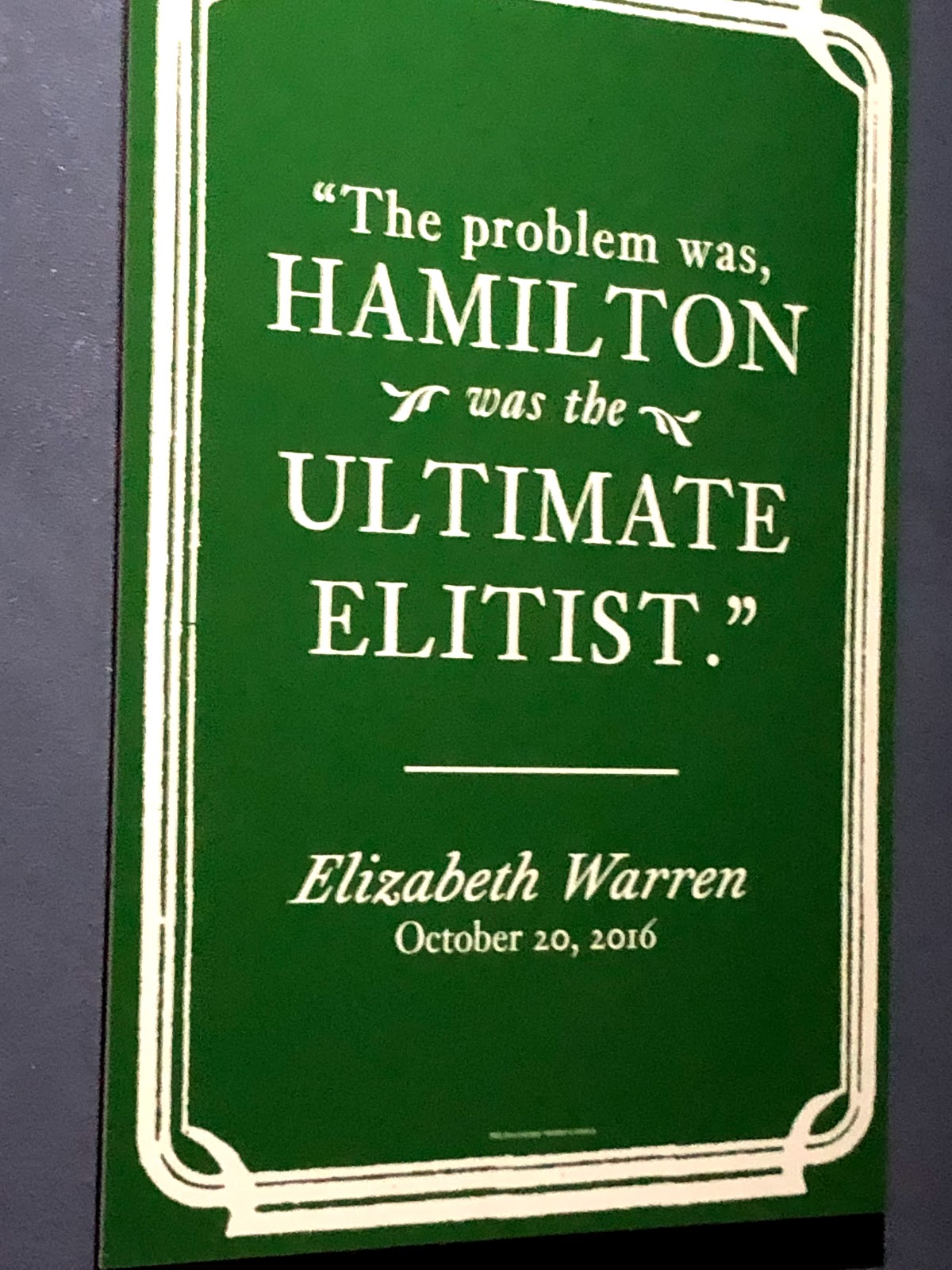
One of my favorite parts was seeing what people over history had said about Hamilton.  He was a divisive figure for sure.  (And Balloon of Malice has to be one of the best insults ever!  Thank you William Carlos Williams!)


And at the very end, you the viewer got to have your say.


The very last room was both intriguing and circular.  It featured the first song about Hamilton (What's Your Name), as performed by the current(?) cast of Hamilton.

 It was great, and I think promises that the inevitable movie of Hamilton the Musical will also be great, but it's a little weird that we didn't start with that song.

I love how it made the circle complete- we are talking about Hamilton, and here's a reminder of the musical.  But I think that if you were going to really make it circular, you should start the whole shebang with this video, which is the video of Lin-Manuel Miranda performing a new song that might be part of a concept album he was making called Hamilton The MixTape.


To get tickets to Hamilton the Exhibition, visit https://hamiltonexhibition.com/

Monday, September 11, 2017

Edgewater Triangle House Tour, September 17


Every year since 1989, the Edgewater Historical Society has presented at least one historical house tour a year. They typically focus on an area of Edgewater approximately 1 mile in diameter, and have 10 or so historic houses to tour.  This year the area being presented is the Edgewater Triangle, 

At each home, a volunteer docent will meet you on the outside of the house, tell you something about the exterior, and then a few at a time, people will be allowed into the interior where another docent will highlight some of the interior features.

 Depending on the owner's wishes, some rooms of the house may not be available for touring.

Reservations are not required.  

To register, visit the Edgewater Baptist Church at 1401 West Hollywood Ave between noon and 4 pm (starred on the map)  and receive your Tour Book and guide.  

The cost of the tour is $25 per person, and the houses are available to tour between noon and 5 pm

The homes that are being visited are on Glenwood, Edgewater, Ridge, Hollywood and Victoria.

The event happens rain or shine!


For more details visit the Edgewater Historical Society's website.

If you look at some of the previous archives of house tours (generously maintained by the society on their website, you'll see this great advertisement for houses in the Edgewater area.  These were being sold by the founder of Edgewater, John Lewis Cochran.  It's fascinating stuff!